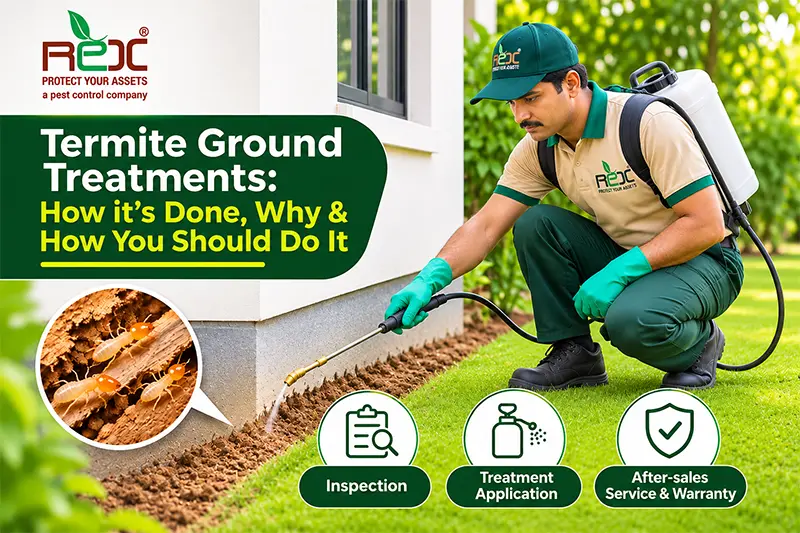
Termite Ground Treatment: How it’s Done, Why & How You Should Do It
Termites will chew your furniture with wood, doors, floorboards and other wooden fixtures and fittings. They’re so adept at hidden tunnels through walls, floors and within the ground that infestations can go completely undetected. Termite Ground Treatment is applied as a preventative measure for inside the building or property grounds.
Overview
The treatment is a pest control process that involves treating selected areas of the soil around or under a building in order to prevent or control any subterranean termite infestation in residential or commercial properties.
Since this kind of pests enters through the soil, the correct application of soil treatment will assist in eliminating the entry points for these pests, making sure that any further movement is restricted. Treatment may either be pre-construction or post-construction depending on whether the structure is a new one or an existing one.
How does it Work?
A professional treatment service typically consists of several key steps.
1. Inspection
A technician checks the building for signs of termite activity, damage to the structure and potential points of entry. During the inspection, the specialist will examine the property for signs of a termite infestation, weaknesses in the building structure and points of entry to detect the most vulnerable areas.
2. Determination of Treatment Zones
Considering the structure of the building, particular areas will include the foundation, the edges of the building, where the wall meets the floor, and many more such areas where the soil touches the building.
Before carrying out any work, the professional will have to take into account the location of underground utilities and the condition of the building.
3. Preparation and Application of the Treatment
A suitable termiticide is selected and applied to the chosen areas in accordance with the instructions and specifications of the product. This step ensures the creation of a treated zone around the building that prevents further termite penetration.
The product, method and dose depend on the task and site conditions – there is no universal termiticide that effectively treats all buildings. A professional technician will choose the right product and apply it correctly to achieve the desired result.
4. Sealing of Access Points
During post-construction treatment, a specialist may need to drill a hole to access the desired location. Drill-fill-seal method is used to treat inaccessible areas from the street or other inaccessible places by drilling, introducing a specialist treatment and closing the hole.
Although sealing the access point will allow the treated surface to return to its original state, this is only one step in the process. It’s essential to ensure that the application is correct and that all termite entry points are treated.
5. After-sales Service and Warranty
After the treatment, the technician should explain the desired outcome, whether additional work is required, and what steps to take to detect and deal with a potential infestation. If the building has already suffered termite damage, other services such as termite repair may be required.
Soil Barrier Treatment vs. Drill-Fill-Seal Treatment
Soil barrier treatment and drill-fill-seal treatment are two procedures that have a lot in common but are used in different situations.
A soil barrier treatment is a general term for a procedure that involves treating the selected ground area with a suitable product to prevent termites from penetrating the building. On the other hand, a drill-fill-seal treatment method is a specific way of treating inaccessible areas by drilling, introducing a treatment and sealing the hole.
A soil barrier can be formed both before the construction of the house and after, while a drill-fill-seal method is used mainly for post-construction treatment.
Pre-construction vs. Post-construction Ground Treatment
Pre-construction and post-construction ground treatment differ primarily in timing and the technician’s access to the building’s foundation.
| Pre-construction Termite Treatment | Post-construction Termite Treatment |
|---|---|
| Performed throughout the construction process before the foundation and floor slabs are covered and inaccessible for treatment. | Performed after the building has been constructed and can have various entry points inaccessible for treatment. |
| Depending on the construction stage, certain areas of the foundation, trenches and other structures may be treated to eliminate current termite infestations and prevent new ones. | A technician inspects the building to identify the most vulnerable spots and develops a strategy to deal with them. In addition, a specialist may need to use a drill-fill-seal method to gain access to the desired locations. |
| The main advantage is that it allows for greater access to open areas of the foundation and soil. In addition, it allows the technician to plan the site preparation work more efficiently, taking into account the future construction of the building. | The main advantage is that it can be used for both residential and commercial buildings. In addition, the technician will develop a strategy that takes into account the unique characteristics of the structure and current access points. |
How Long Does Termite Ground Treatment Last?
There is no universal answer to how long the treatment lasts, as it depends on several factors. First of all, the most appropriate product should be selected, as its effectiveness, application technology and warranty conditions are specified individually for each structure. In addition, special attention should be paid to the quality of installation, since incorrect installation or insufficient coverage of treatment zones will negatively affect the results.
Ask your technician for recommendations regarding the product, installation technology and warranty conditions, as these issues directly affect the final results.
What Are the Signs That I Need the Treatment?
If you notice any of the signs of a termite infestation, it is necessary to contact a professional service to inspect the building:
- Presence of termite mud tubes made of soil and wood dust;
- Damaged wooden buildings;
- Signs of termite activity near the floor-wall junction;
- Signs of termite swarms near windows and doors;
- Multiple observations of termites in the house;
- Signs of a previous termite infestation that has been treated but has re-infested.
A professional inspection will provide you with the best solution for your situation, as the technician will consider the species of termites, the location of their nests and the state of the building.
How to Choose a Safe and Licensed Termite Treatment Service?
Here are some of the most critical factors to consider when choosing a termite treatment service:
- Check the Company’s Licenses and Approvals
- Clarify the Permitted Use and Characteristics of the Chosen Product
- Clarify the Details of the Chosen Treatment Method
- Study the Safety Regulations and Precautions
- Get a Written Estimate of the Work and Warranty Conditions
Why Choose Rex Environment Science?
Rex Environment Science Pvt. Ltd. provides residential and commercial pest control services in Ahmedabad, Gujarat. We offer services like chemical termite barrier treatment and post-construction drill-fill-seal methods. Rex Environment Science has vast experience in termite control.
Conclusion
In conclusion, termite ground treatment helps protect buildings from termite infestations if the correct method is chosen and the procedure is correctly performed. Pre-construction ground treatment allows the most comprehensive protection by treating previously inaccessible areas. At the same time, post-construction treatment is a convenient option for property owners whose buildings have already been constructed.
For property owners in Ahmedabad, Gujarat, Rex Environment Science offers a wide range of termite control services. By visiting the pest control company’s website, you will find out what methods it uses and request an inspection. Contact Rex Environment Science to discuss the treatment and select the procedure that’ll best suit your needs.
FAQs
Looking to get secure?
Contact REX Environment Science to discuss the next steps.
Book Free Inspection
